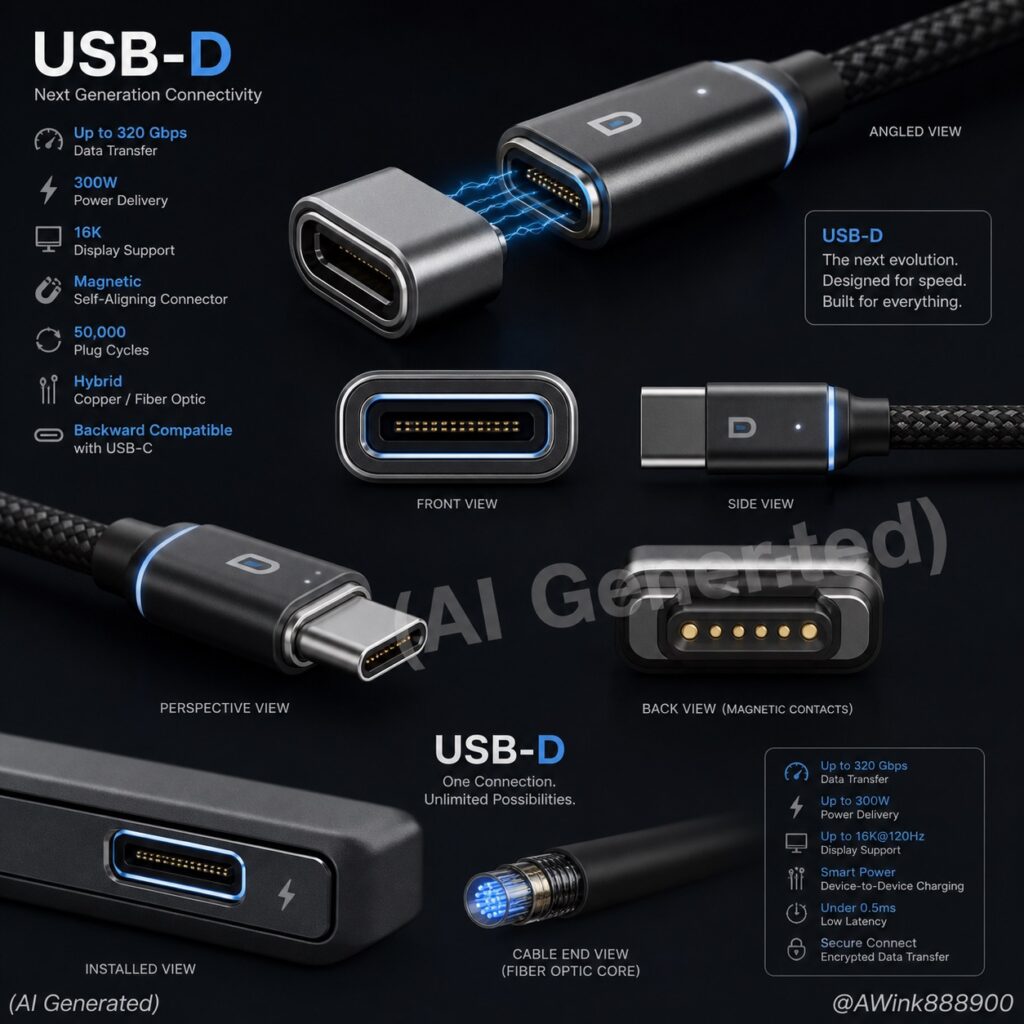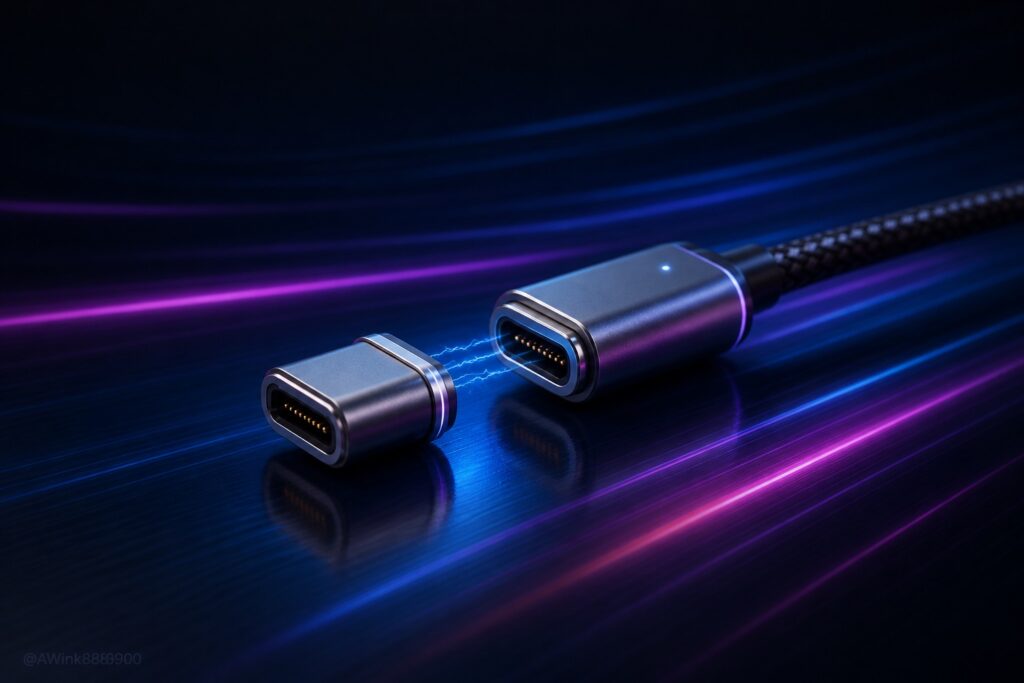
This is a prediction. USB-D has not been announced, confirmed, or officially named by the USB Implementers Forum, Apple, Intel, or anyone else. This is simply a fun and realistic look at what the next major USB standard could become based on where technology appears to be heading.
USB-C was a massive improvement over the mess of cables we had before it. It gave us one reversible connector for charging, data, displays, phones, tablets, laptops, docks, monitors, and a bunch of random devices we pretend we organized but absolutely did not.
But USB-C is not the finish line.
As laptops get thinner, displays get sharper, external storage gets faster, AI devices become more common, and people keep expecting one little cable to do basically everything short of making dinner, it seems obvious that we will eventually need another jump forward.
That is where I think USB-D could come in.
What USB-D Could Be
My prediction is that USB-D would not just be “USB-C, but faster.” That would be boring, and we have enough boring technology already. USB-D should solve the things that still annoy people about cables. The big idea? A magnetic, self-aligning connector with hybrid copper and fiber optic data lanes. In plain English, it would snap into place more easily, transfer data much faster, charge more powerful devices, and possibly support longer high-speed cables without the weird limitations we deal with today.Predicted USB-D Specs
Here is what I think a believable USB-D standard could look like:- Up to 320 Gbps data transfer
- 300W intelligent power delivery
- Magnetic self-aligning connector
- Hybrid copper and fiber optic cable design
- Support for 16K displays
- 50,000+ plug cycles
- Smart device-to-device charging
- Built-in secure connection authentication
- Backward compatibility with USB-C through an adapter
Why Magnetic Makes Sense
USB-C is reversible, which was a huge win. But magnetic would be the next obvious improvement. Think about it. A magnetic USB-D cable could snap into place automatically, reduce wear on ports, disconnect safely if someone trips over the cable, and make plugging in a device easier in the dark, behind a desk, or while blindly reaching around the back of a monitor like a raccoon searching for snacks. Apple had MagSafe for years, and people still love the basic idea. A universal magnetic standard would make a lot of sense, especially if it could handle serious power and high-speed data at the same time.Why Fiber Optic Could Be Part of the Future
The faster cables get, the harder it becomes to push massive amounts of data through traditional copper over longer distances. That is why I think a future USB-D cable could use a hybrid design: copper for power and short-distance compatibility, fiber optic lanes for high-speed data transfer. This would be especially useful for creators, gamers, developers, offices, studios, and anyone moving huge files between external drives, computers, docks, cameras, and displays. A cable that can handle high-speed storage, multiple displays, power delivery, and low latency without needing a pile of adapters would be a big deal.What USB-D Would Be Used For
If USB-D ever becomes real, I do not think it would start with cheap accessories. It would probably show up first in expensive laptops, docks, monitors, external GPUs, professional storage, and high-end creator equipment. Then, like everything else, it would slowly trickle down into normal consumer devices once the price comes down and everyone stops pretending they are not going to need another new cable. Possible USB-D uses could include:- Ultra-fast external SSDs
- 16K monitors
- Multi-display docking stations
- VR and AR headsets
- External graphics devices
- AI hardware accessories
- Professional video editing setups
- High-powered laptop charging
The Best Part: Fewer Cable Problems
The dream is simple. One cable that charges your laptop, runs your monitor, moves massive files, powers your dock, connects your accessories, and does not make you question your life choices every time it fails to work for no obvious reason. USB-C got us closer to that world, but it also created plenty of confusion. Some USB-C cables charge. Some transfer data quickly. Some support displays. Some do all three. Some look identical and do almost nothing useful. It is a beautiful disaster. USB-D would need better labeling, smarter device communication, and clearer standards from day one.My USB-D Prediction
If I had to write the short prediction, it would be this: Late 2031. USB-D. Magnetic connector. Hybrid copper and fiber optic cable. Up to 320 Gbps. 300W power delivery. 16K display support. Smart device-to-device charging. Backward compatible with USB-C. – predictionFinal Thoughts
USB-D is not real yet. But something like it probably needs to happen eventually. We are asking more and more from one little port. Faster storage. Better displays. More charging power. Cleaner desk setups. More reliable docking. Better support for future devices that have not even become annoying yet. USB-C was the cleanup phase. USB-D could be the “finally, this actually works the way normal people expected it to work” phase. And honestly, that would be a beautiful thing.