
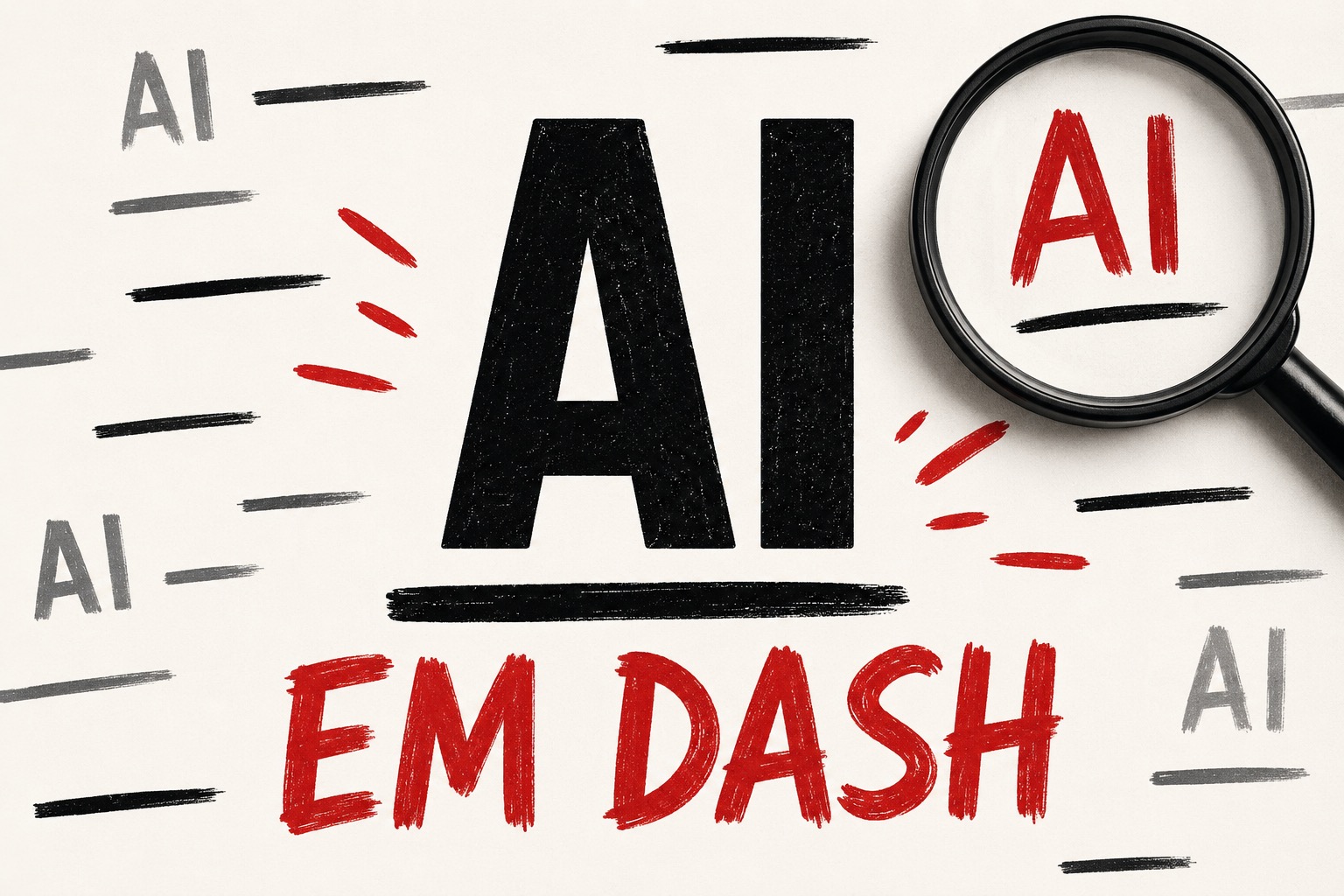
💡 I have a proposal…
And before anyone gets upset, please understand that this is not a serious proposal. I’m not organizing a movement. I’m not starting a petition. I’m not planning to debate strangers on Facebook for six hours.
😂 I just think this whole thing is funny.
✨ I think we should all start using em dashes.
Not because they’re better punctuation.
Not because they make us sound smarter.
Not because English teachers everywhere are demanding it.
I think we should do it because apparently em dashes are now proof that something was written by AI.
At least according to a growing number of internet detectives.
🤔 But before I continue, I should admit something.
👉 The premise itself is probably wrong.
✅ Em Dashes Are Not an AI Thing
They’ve been around forever. Authors used them. Journalists used them. Publishers used them. People were using em dashes when computers took up an entire room and had less processing power than a modern toaster.
Yet somehow we’ve reached a point where people see one and immediately think:
“ChatGPT wrote this.”
It’s honestly impressive.
Imagine applying the same logic to anything else.
🕵️ “He used a semicolon. Clearly a robot.”
🕵️ “She spelled everything correctly. Suspicious.”
🕵️ “This paragraph has proper grammar. No human would ever do that.”
Case closed.
We got him.
The funny part is that the people making these accusations are often using technology that would have looked like science fiction just twenty years ago. They’re posting from smartphones with more computing power than NASA had during the moon landing, but they’ve decided a punctuation mark is the smoking gun.
🗑️ Bad Content Is Not New
And look, I understand where some of this comes from.
The internet is full of low-quality AI content.
It’s also full of low-quality human content.
Let’s be fair here.
Some of the worst writing I’ve ever seen was created entirely by people.
No artificial intelligence was involved whatsoever.
Just pure, natural stupidity.
Organic. Free-range stupidity.
Locally sourced.
The real issue isn’t whether AI was involved.
The real issue is that we’ve started looking for shortcuts.
Instead of asking whether something is useful, interesting, accurate, or entertaining, we’re trying to determine how it was created.
We’re inspecting the fingerprints instead of looking at the painting.
We’re examining the hammer instead of judging the house.
We’re becoming less interested in the message and more interested in the manufacturing process.
And I don’t think that’s a great trend.
🧠 The Idea Still Matters
If someone writes something helpful, does it suddenly become less helpful because they used a tool?
If someone writes something ridiculous, does it magically become brilliant because a human typed every word by hand?
Of course not.
The value of an idea should probably depend on the idea.
I know. Radical concept.
But this whole conversation reminds me of something bigger.
Human beings love simple rules.
We like shortcuts.
We like easy answers.
We like being able to say, “Aha! I found the clue!”
The problem is that reality is usually more complicated.
Some AI writing is terrible.
Some AI writing is excellent.
Some human writing is terrible.
Some human writing is excellent.
And some writing is so average that nobody should spend more than three seconds thinking about who wrote it.
Yet here we are, conducting forensic investigations over punctuation marks.
✍️ So Let’s Create Total Confusion
That’s why I think we should all start using em dashes.
Use them in emails.
Use them in text messages.
Use them in Christmas cards.
Put them in grocery lists.
Use them so often that future historians become completely bewildered.
Maybe throw in a semicolon while you’re at it.
Use a word like “furthermore.”
Start a sentence with “however.”
Let’s make the internet detectives work for it.
🔎 Maybe We Should Ask Better Questions
Or maybe the better solution is this:
Let’s stop pretending we can determine the origin of every piece of writing by spotting a few patterns.
Let’s stop acting like punctuation is evidence.
Let’s stop treating grammar like a crime scene.
Instead, maybe we should focus on whether the content is actually worth reading.
Ask better questions:
✅ Was it useful?
✅ Was it interesting?
✅ Did it make you think?
✅ Did it make you laugh?
Those questions seem a lot more important than whether somebody used a long horizontal line.
And Now for the Part That Might Annoy Some People
This article was written with AI.
Not entirely by AI. Not entirely by me. Somewhere in the middle.
I had the idea. I provided the direction. AI helped organize it and put words on the page.
So, did you know?
Did you spot it immediately?
If so, how?
Was it the em dashes?
The sentence structure?
The vocabulary?
Or did you simply assume that certain patterns must mean AI was involved?
That’s the point.
The internet is becoming obsessed with identifying how something was written instead of asking whether it was worth reading in the first place.
Maybe you detected AI.
Maybe you didn’t.
Maybe you were completely wrong.
And maybe that’s bad news for your AI detector.
Or maybe it’s bad news for all of us if we think punctuation marks are enough evidence to solve the case.